

The Price Transparency Enforcement Gap: Hospitals Got the Warning. Health Plans and TPAs Are Next.
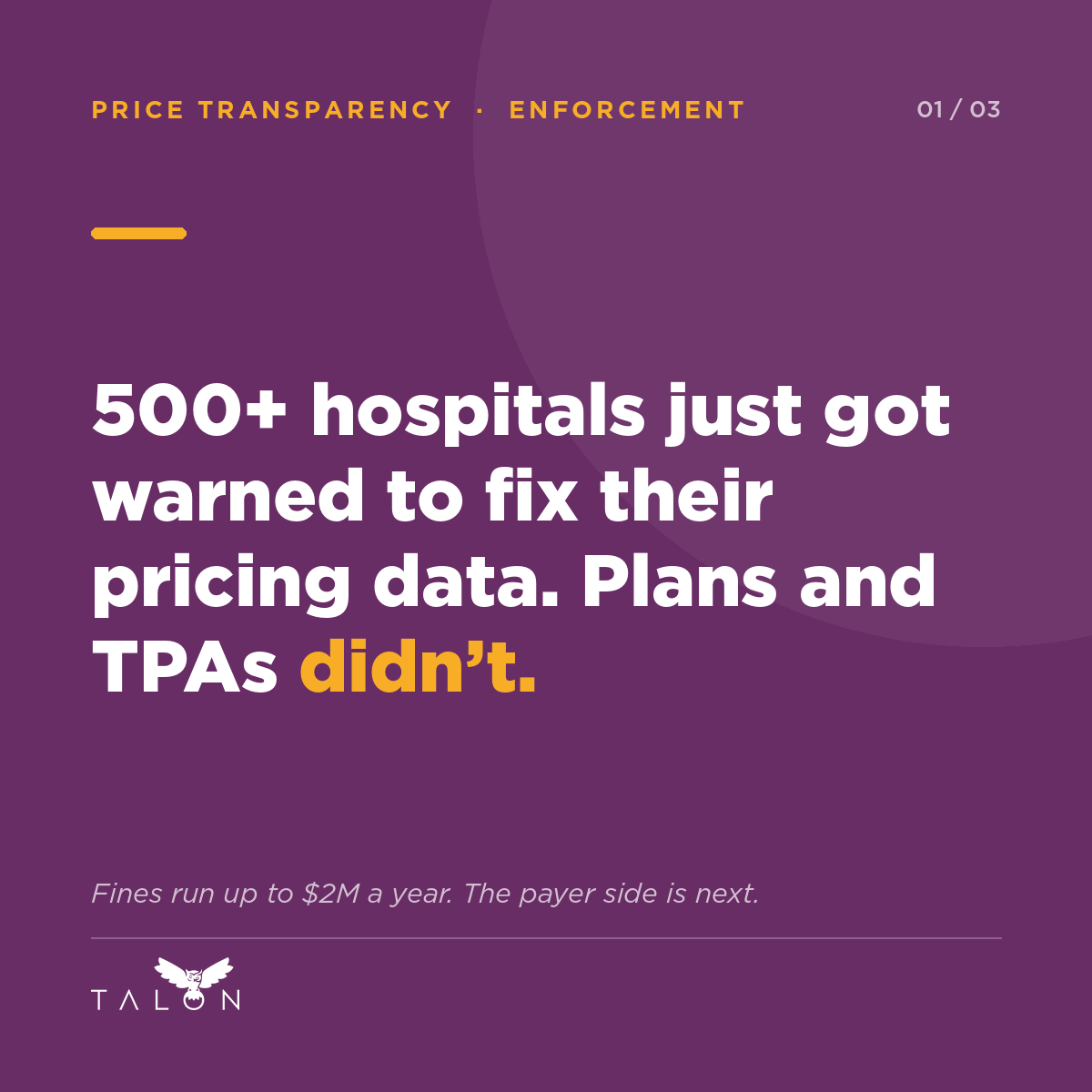
This month, the Associated Press reported that federal regulators warned more than 500 hospitals to fix their price transparency data or face fines of up to $2 million a year. The list the AP obtained covers 519 enforcement actions reaching every state except Alaska, plus Washington, D.C. For most of the market, the instinct is relief: the scrutiny landed on hospitals, not on plans, TPAs, or employers. That instinct is a mistake. These warning letters are not a hospital story. They are a signal about where price transparency enforcement is heading next.
What actually happened
Since April, regulators have sent warning notices and, in more serious cases, requests for corrective action plans to hospitals that were not posting clear, usable pricing data. It is worth being precise about two things. First, no fines have been levied yet. The $2 million figure is the annual maximum for a facility that refuses to come into compliance, not a penalty already imposed. Second, the action was about making existing rules enforceable rather than aspirational, and officials signaled that more letters are on the way.
The geographic spread tells the real story. Texas led with 42 actions, followed by California with 38, Indiana with 34, and Louisiana with 27. But the warnings reached 49 states and D.C. This is not a regional cleanup. It is a national enforcement posture, and it is just getting started.
Why this is a signal, not a hospital problem
The hospital price transparency rule and the Transparency in Coverage rule are two halves of the same federal effort. Hospitals publish their standard charges. Health plans and TPAs publish machine-readable files of in-network rates and allowed amounts. Both sides of the system are now sitting on public, machine-readable pricing data. Enforcement simply started on the hospital side, where the files are most visible and the story is easiest to tell.
So the reasonable read is not “we dodged it.” It is “we are earlier in the same timeline.” The exact questions regulators are now putting to hospitals, are your files complete, are they accurate, are they usable, apply directly to the files that plans and TPAs already publish today.
As scrutiny increases, defensibility, not disclosure, becomes the standard.
The gap is not compliance. It is capability.
Here is the structural point most organizations miss. Posting a machine-readable file is not the same as governing the prices inside it. Visibility without governance is noise. A plan can be technically compliant, with its file posted and its schema valid, and still be sitting on data that no employer, broker, or member can actually use to make a decision.
That is the real enforcement gap. The first wave of transparency rules tested whether the data exists. The next wave, already visible in how regulators are framing the hospital warnings, tests whether the data is legitimate and usable: actual prices instead of estimates, complete instead of full of gaps, and structured so a person can compare real options. For plans and TPAs, that shift changes the math. Compliance becomes table stakes. The differentiator becomes whether you can turn your own disclosed rates into something an employer client or a member can act on, before the rules require everyone to.
What forward-leaning plans and TPAs do now
The organizations that win the next 24 months will not be the ones scrambling to post a file when their warning letter arrives. They will be the ones already treating the data they publish as an asset rather than a liability. Three moves separate them:
- Audit your own files the way a regulator would. Judge completeness and accuracy, not just whether the file is posted.
- Turn disclosed rates into decision-ready price signals. A machine-readable file is a phone book. A price signal tells a member what a specific procedure will actually cost, where, and how that compares.
- Pair the signal with a reason to act. Information alone does not change behavior. Aligned incentives do.
Where TALON fits
This is the gap TALON was built to close. TALON turns the disclosed rates already sitting in machine-readable files into decision-ready price signals, then pairs them with a patented incentive engine that gives members a financial reason to choose well. The platform maintains 99.9% coverage of published machine-readable files and draws on a database of more than 25 billion claims, so the price a member sees reflects what care actually costs in their own market rather than a national average or an estimate. Tools like MyMedicalShopper™ put that signal in front of the member at the moment of decision.
This is not theoretical. Providence Health Plan rebuilt its pipeline on TALON and cut its monthly MRF cycle from 45 days to less than one, with CMS Schema 2.0 compliance maintained automatically and no manual steps. The same Facets claims data that produces its compliance file also powers the cost-comparison tool its members use, so what they see is not an approximation of the published rates. It is the published rates, made useful.
The point is not compliance. Compliance is a byproduct. The point is that the same public data regulators are now enforcing against can become the most valuable thing a plan or TPA brings to an employer relationship.
The bottom line
The 519 warning letters are the call for a more concrete, transparent foundation. Hospitals are first because their files are the most visible, not because they are the only ones publishing pricing data. Health plans and TPAs publish too, and the standard is already moving from “did you disclose it” to “can you stand behind it, and can anyone use it.” The organizations that act on that now will own the employer relationship. The ones that wait will inherit a commodity.
If you are a health plan or TPA sitting on machine-readable files you have never turned into member value, that is the conversation to have now.
See how TALON turns disclosed rates into decision-ready price signals
This lets you guide employers without owning prices you do not set.
TALON is a healthcare technology company focused on restoring market function in healthcare by making price transparency actionable. Founded in 2014 and headquartered in Portsmouth, NH, TALON’s platform turns disclosed rates into decision-ready price signals, paired with a patented incentive engine that drives real behavior change and measurable cost reduction. Making Healthcare Make Sense.